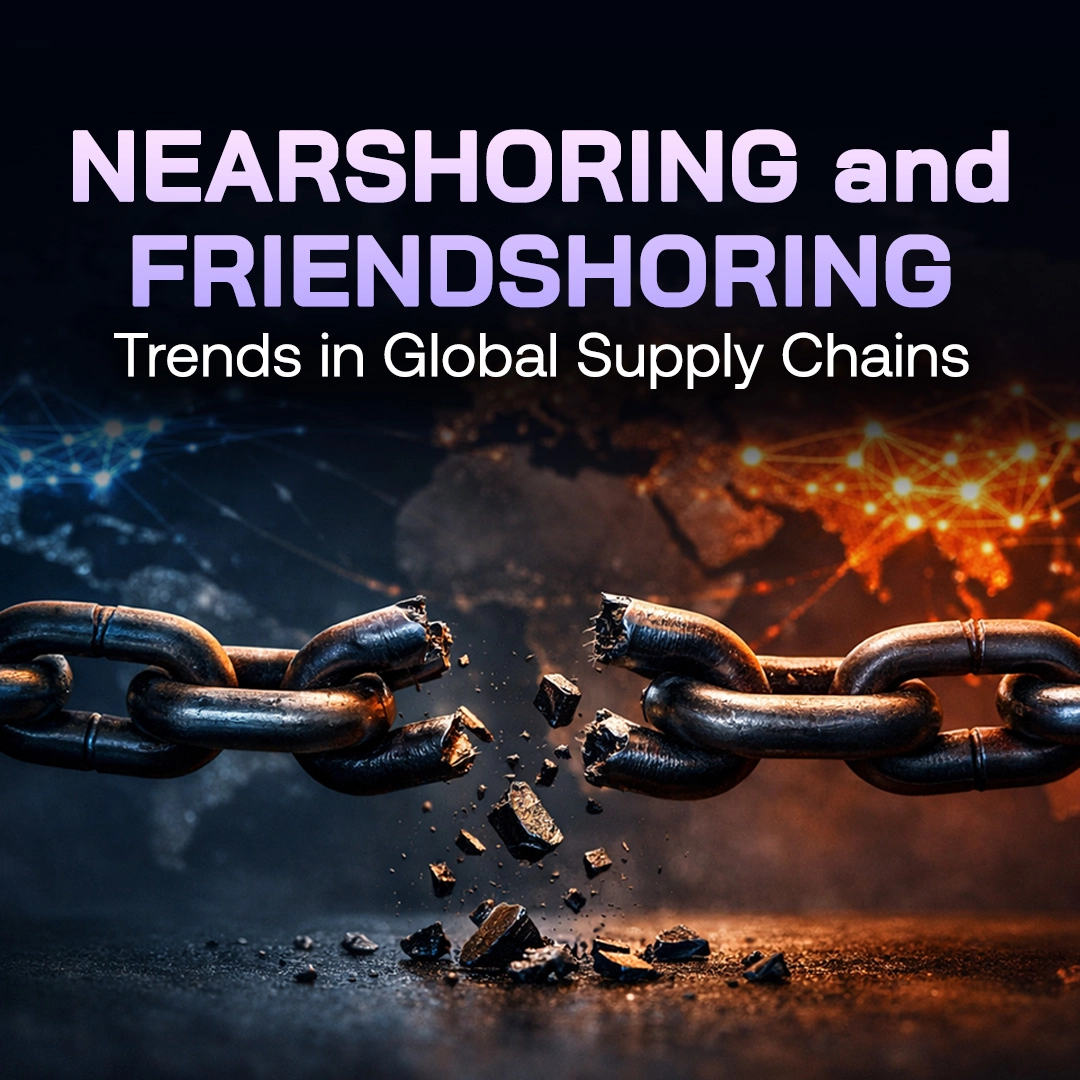
Global supply chains are going through a structural transformation. For decades, companies built production networks around low-cost labor, large-scale manufacturing and long-distance logistics. Today, those priorities are being rebalanced. Rising geopolitical risks, shipping disruptions, trade restrictions and the need for faster delivery are pushing companies to rethink where and how they source, manufacture and distribute goods.
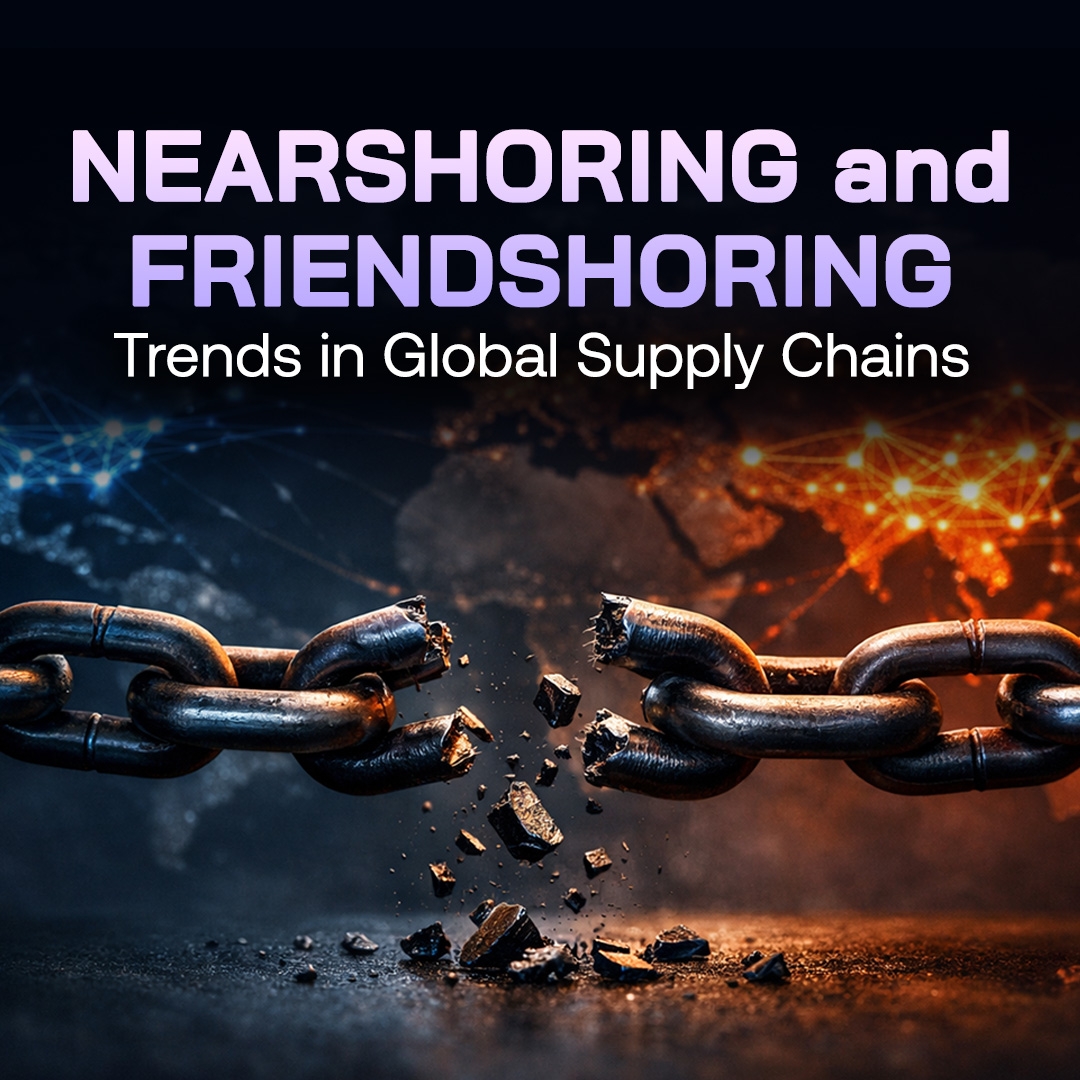
This is where nearshoring and friendshoring
have become two of the most discussed strategies in international trade. While
both approaches aim to reduce risk and improve resilience, they are not the
same. They represent different ways of designing supply chains for a world
where cost is still important, but stability and security matter more than
ever.
1. What Are Nearshoring and Friendshoring?
The shift toward regionalization is not a
temporary trend. It reflects long-term changes in how businesses view global
trade. Instead of asking, “Where is production cheapest?”, many firms now ask,
“Where is production safest, most reliable and closest to demand?”
1.1. Definition and Core Characteristics of Nearshoring
The concept of nearshoring refers to relocating
manufacturing or sourcing activities to a country that is geographically closer
to the company’s main market. In other words, it is a supply chain strategy
designed to reduce distance.
The term nearshoring def can be
summarized simply: moving production closer to customers to reduce shipping
time, transportation costs and supply chain disruption risks. Companies
typically choose nearshore locations that offer:
- Shorter transit times
- Easier coordination across time zones
- Better visibility and control
- Lower logistics and inventory costs
For example, a United States company that
previously sourced components from East Asia may move production to Mexico,
Central America or parts of South America. A European manufacturer might shift
supply networks toward Eastern Europe, North Africa or Turkey.
1.2. Definition and Strategic Logic of Friendshoring
While nearshoring is based on geography,
friendshoring is based on geopolitics and trust. The idea is to shift supply
chains toward countries that are considered politically aligned, stable and
reliable trade partners.
The friendshoring definition is commonly
described as sourcing and manufacturing within a network of allied or
“friendly” nations to reduce exposure to political tensions, sanctions, export
controls or sudden policy shifts.
This strategy gained momentum as governments
and multinational corporations realized that supply chains can be vulnerable
not only to natural disruptions but also to diplomatic conflict. Friendshoring
often focuses on:
- Strategic industries (semiconductors, energy,
medical supplies)
- National security and critical infrastructure
- Long-term economic partnerships
- Predictable regulatory environments
1.3. How They Differ from Offshoring and Reshoring
To understand these strategies clearly, it
helps to compare them with the older supply chain models:
Offshoring: Moving production to a distant country,
usually for lower costs (for example, manufacturing in Asia for U.S. or
European markets).
Reshoring: Bringing production back to the company’s home
country.
Nearshoring: Moving production closer to the target market
(regional approach).
Friendshoring: Moving production to politically aligned
nations (trust-based approach).
A key point is that nearshoring and
friendshoring can overlap. A company might choose a country that is both close
and politically aligned. But they are still different strategies with different
decision-making priorities.
2. Why Are Companies Moving Away from Traditional Offshoring?
Traditional offshoring dominated global trade
because it offered a simple value proposition: lower production costs. However,
recent global events exposed the hidden risks of long-distance supply chains.
One major factor was the COVID-19 pandemic,
which disrupted ports, shipping routes and production centers. Companies
realized that a single factory shutdown on the other side of the world could
stop an entire industry. Then, geopolitical tensions and trade conflicts made
long-distance dependency feel even more fragile.
Another reason is inflation in global shipping
and logistics. Even when production is cheaper abroad, transportation costs and
delivery delays can eliminate the savings. At the same time, customers in many
industries now expect faster fulfillment, real-time tracking and stable
inventory.
Finally, governments are becoming more active
in shaping supply chain decisions. Export controls, sanctions, industrial
policies and incentive programs have increased, encouraging firms to relocate
strategic production into safer networks.
3. Strategic Benefits of Nearshoring
The main benefit of nearshoring is that it
reduces distance, and distance in supply chains creates both cost and
uncertainty.
First, nearshoring shortens lead times. When
production is closer to demand, companies can respond faster to changes in
customer needs. This is especially valuable in industries where product cycles
are short, such as consumer electronics, automotive parts, fashion and packaged
goods.
Second, nearshoring improves supply chain
flexibility. Companies can place smaller orders more frequently instead of
relying on massive shipments. This reduces the need for large warehouses and
expensive inventory buffers.
Third, nearshoring can reduce operational risk.
Long-distance supply chains depend heavily on global shipping lanes, port
capacity and international logistics stability. Nearshoring shifts some of that
risk into regional trucking, rail or shorter sea routes, which are often easier
to manage.
Another major advantage is communication. Time
zone differences and long coordination cycles can slow down decision-making.
Nearshore suppliers often allow faster collaboration, quality control and
production adjustments.
For many firms, nearshoring is not about
replacing global trade entirely; it is about building a more balanced network
where the most critical components are produced closer to the market.
4. The Political and Economic Logic Behind Friendshoring
Friendshoring has grown because supply chains
are no longer seen as neutral economic systems. In today’s environment, trade
relationships can become political overnight.
Governments increasingly focus on supply chain
security for critical industries such as:
- Semiconductors
- Batteries and electric vehicles
- Medical supplies and pharmaceuticals
- Defense-related manufacturing
- Energy and rare earth materials
The logic is clear: if a country depends
heavily on a geopolitical competitor for strategic goods, it becomes
vulnerable. Friendshoring aims to reduce that vulnerability by building supply
networks among trusted partners.
From an economic standpoint, friendshoring also
supports stable long-term investment. Companies are more likely to invest in
factories, joint ventures and supply partnerships when they believe the
political relationship between countries will remain strong.
In practice, friendshoring often appears in
trade agreements, strategic partnerships and government incentive programs.
These can include tax benefits, subsidies, tariff reductions and infrastructure
support.
The result is that supply chains are becoming
more “aligned” rather than purely “optimized.”
5. Cost, Efficiency, and the New Supply Chain Trade-Off
For years, supply chain strategy was built
around efficiency. The cheapest supplier, even if located far away, often won.
Today, businesses are making a different trade-off: resilience over pure cost.
Nearshoring and friendshoring can increase unit
production costs compared to traditional offshoring. Labor might be more
expensive, and some nearshore regions may not have the same manufacturing scale
as large Asian hubs.
However, companies increasingly measure total
cost of ownership, not just production cost. Total cost includes:
- Shipping and insurance
- Inventory and warehousing
- Delays and stockouts
- Quality problems
- Risk of political disruption
- Compliance and regulatory costs
In many cases, a slightly higher production
cost is justified if it reduces the probability of major disruption.
This is why nearshoring is often described as a
“risk management strategy” as much as a cost strategy. Similarly, friendshoring
is seen as a way to reduce exposure to political and regulatory uncertainty.
6. Regional Supply Chain Hubs on the Rise
One of the clearest outcomes of nearshoring is
the rise of new regional supply chain hubs. These countries attract
manufacturing investment thanks to their geographic advantages, trade
agreements, workforce availability and improving logistics infrastructure.
The most visible example is Mexico’s
nearshoring. The idea of nearshoring in Mexico has accelerated because
Mexico is close to the United States, benefits from the USMCA trade agreement,
and already has strong manufacturing capabilities in sectors like automotive,
electronics and industrial goods.
In Europe, companies increasingly shift
sourcing toward Eastern Europe and Turkey to shorten delivery times and reduce
dependency on distant suppliers. Meanwhile, many businesses in Asia diversify
production across Southeast Asia to reduce concentration risk. Beyond Mexico,
several Latin American economies are also gaining attention as alternative
sourcing hubs for specific industries.
7. Challenges and Limitations of Nearshoring and Friendshoring
Despite their benefits, these strategies also
come with real limitations. Companies that assume nearshoring or friendshoring
is an easy solution may face unexpected difficulties.
One major challenge is capacity. Some nearshore
locations do not yet have the industrial scale, supplier networks or
infrastructure needed to support large global manufacturing shifts. Even if a
country is geographically close, it may lack specialized suppliers, skilled
labor or reliable energy systems.
Another challenge is cost inflation. As
nearshoring demand rises, wages, land prices and industrial rental costs can
increase quickly. This has been seen in some manufacturing hubs where foreign
investment grows faster than infrastructure development.
Friendshoring also introduces complexity.
Politically aligned countries may still have regulatory differences, local
content rules or compliance requirements. In addition, geopolitical alignment
can change over time. A country considered a “friend” today may face political
instability tomorrow.
There is also the issue of over-concentration.
If too many firms move to the same “safe” regions, new bottlenecks can emerge.
Supply chains may become less global but not necessarily less fragile.
Finally, not every industry can easily
nearshore. Highly specialized manufacturing, such as advanced semiconductors,
requires deep ecosystems that cannot be rebuilt quickly. In such sectors,
companies often adopt hybrid strategies: nearshore some components, diversify
suppliers and maintain global production for scale.
8. How TradeAtlas Helps Businesses Track Nearshoring and Friendshoring Shifts
Nearshoring and friendshoring are not just
abstract concepts; they are measurable changes in trade flows, supplier
relationships and market demand. Businesses that want to benefit from these
shifts need real data, not assumptions.
TradeAtlas helps importers, exporters and
global sourcing teams analyze how supply chains are evolving across regions and
industries. By using trade data, companies can identify which countries are
gaining export share, which supplier networks are expanding and where new
demand clusters are forming.
For example, businesses tracking Mexico
nearshoring trends can use TradeAtlas to monitor United States-Mexico trade
volumes by sector, identify fast-growing exporters and discover importers
actively shifting supply sources. Similarly, companies exploring friendshoring
can analyze trade relationships among politically aligned economies and detect
new sourcing corridors.
With TradeAtlas, companies can make supply
chain decisions based on verified import-export records, market trends and
competitor movements, turning global uncertainty into strategic advantage.
Ultimately, nearshoring and friendshoring are
not temporary shifts, but defining strategies shaping modern trade.