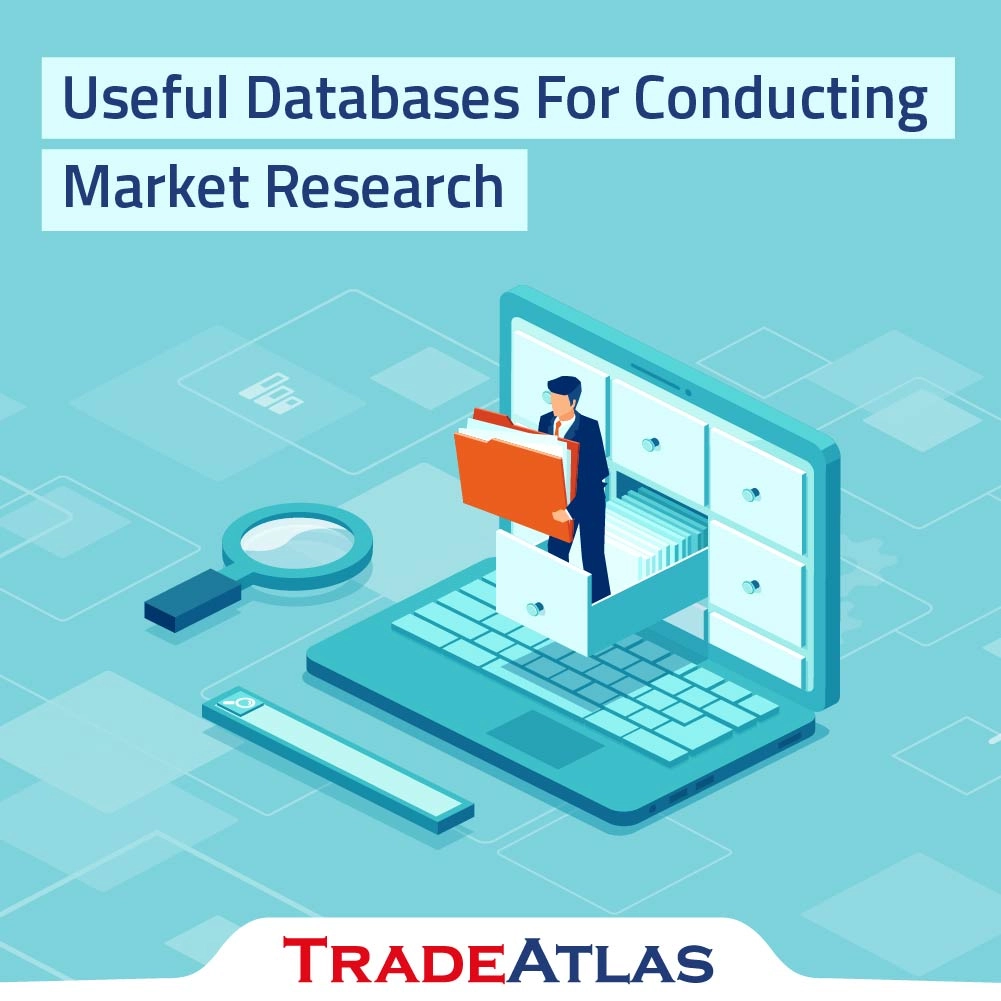
Entering a market is the most important issue for companies that will be dealing with foreign trade and for companies that are currently dealing with it when choosing a new product and a market. Knowing and understanding a market as deeply as possible greatly increases the maneuverability of companies. Conducting market research effectively is crucial in this process.
In recent years, United Nations (UN),
World Trade Organization (WTO), World Bank, and International Chamber of
Commerce (ITC) have created large databases for market research in
this field and made them available to companies. These resources help
businesses analyze market trends, trade data, and regulations. Information such
as customs duties, trade barriers, non-duty barriers, target market insights,
procedures, and formalities are included in these databases and provide great
convenience to companies.
For businesses looking for the best databases for market research,
some of the most comprehensive and reliable sources include:
1. International Export Potential Map
The Export
Potential Map identifies export diversification opportunities as well as
containing information on products, markets and suppliers with export potential
for 226 countries and regions and 4,376 products. Based on the International
Trade Center’s (ITC) export potential methodology, it evaluates and categorizes
export performance, target market demand and market access conditions, as well
as bilateral links between the exporting country and the target market, to
provide a unique ranking of untapped opportunities, making them understandable
to users.
2. International Trade Center Market Access Map
Market
Access Map is a free analytical portal that allows exporters and importers to
access, compare, analyze, and download tariffs, tariff-rate quotas, trade
solutions and non-tariff measures that may apply to a given commodity in any
market in the world. The web application is interactive, simple and easy to
use. On the homepage you can find tariff information and other market entry
requirements quickly, easily and for free.
3. EU Market Entry Database
Access2Markets
is the new portal for EU exporters and importers, where they can find detailed
information on tariffs, duties of origin rules and surcharges, import
procedures and formalities, product requirements, trade barriers, and trade
flow statistics.
4. International Trade Center Global Trade Helpdesk
The Global
Trade Helpdesk (GTH) is an initiative jointly managed by ITC, UNCTAD (United
Nations Conference on Trade and Development) and the World Trade Organization,
which aims to simplify market research for companies and especially micro,
small and medium enterprises by integrating trade and business information.
Using the Global Trade Helpdesk, companies can compare demand for their
products across markets, discover tariffs and other market access conditions,
access buyer details, navigate domestic export processes, and find business
partners.
5. EuroMed Trade Helpdesk
EuroMed
Trade Helpdesk, in cooperation with the EU Export Helpdesk, aims to facilitate
trade and investment in the European Mediterranean Region. It is an institution
established to analyze business opportunities and market access requirements or
to provide more market information services on Algeria, Egypt, Israel, Jordan,
Lebanon, Morocco, Palestine and Turkey. EuroMed Helpdesk is available in
English, French, Arabic and Turkish.
6. Doing Business Database
Doing
Business, the finest publication of the World Bank, is a series of annual
studies that measure the regulations that foster and restrict business
activity. Doing Business provides quantitative data on business regulation and
property rights protection that can be compared across 190 economies and time,
from Afghanistan to Zimbabwe.
7. World Bank WITS Simulation
World Bank
WITS Simulation is a trading software provided by the World Bank for users to
query various international trade databases. WITS allows the user to query
trade statistics from the United Nations' official repository of international
trade statistics and related analytical tables (UN COMTRADE), tariff and
non-tariff measures (Non-Tariff Measures).
8. World Trade Organization I-TIP Portal
I-TIP
provides comprehensive information on non-tariff measures implemented by WTO
members on trade in goods. The information includes members' notices of
unexplained trade barriers, i.e., as well as information on specific trade
concerns raised by members at WTO committee meetings. Its purpose is to serve
the needs of those seeking summary information as well as those seeking
detailed information on trade policy measures.
9. ePing
Product-related
notifications are regularly published within the World Trade Organization. WTO
notifications contribute to the prevention of technical barriers by ensuring
transparency in the legislation and practices of countries. Through
notifications, you can learn about the regulations of other countries that may
adversely affect your exports at the draft stage, comment and have them
changed. A joint venture of the United Nations, World Trade Organization and
ITC, ePing is an online tool that enables private and public stakeholders to
access and understand WTO notifications in a timely manner affecting
products and markets of interest.
10. International Trade Center Non-Tariff Measures Survey
ITC
conducts large-scale surveys of companies to improve knowledge on current
non-tariff barriers by providing detailed qualitative impact analysis and
addressing key stakeholders directly. Based on the experience and knowledge of
exporters and importers who have to deal with these measures, these surveys are
a viable and proven mechanism to deepen understanding of the perception of
non-tariff measures, which is inherently difficult to quantify.
How TradeAtlas Can Help with Market Research
TradeAtlas is a powerful trade intelligence platform that provides
companies with access to detailed import-export data, helping them conduct
market research more effectively. With its vast database, businesses can
analyze trade flows, identify potential buyers and suppliers, and assess
competitor activities in global markets. By leveraging TradeAtlas, companies
can make data-driven decisions, reduce risks, and seize new trade opportunities
with confidence. If you want to explore TradeAtlas for free, you can click here.
For detailed information on the subject of technical barriers to
trade, you can review the content “Technical Barriers to
Trade”.